
Voting Rights Under Siege
A Historical and Contemporary Analysis of Voting Rights Suppression in the United States (1776–2026) - With AI Assistance

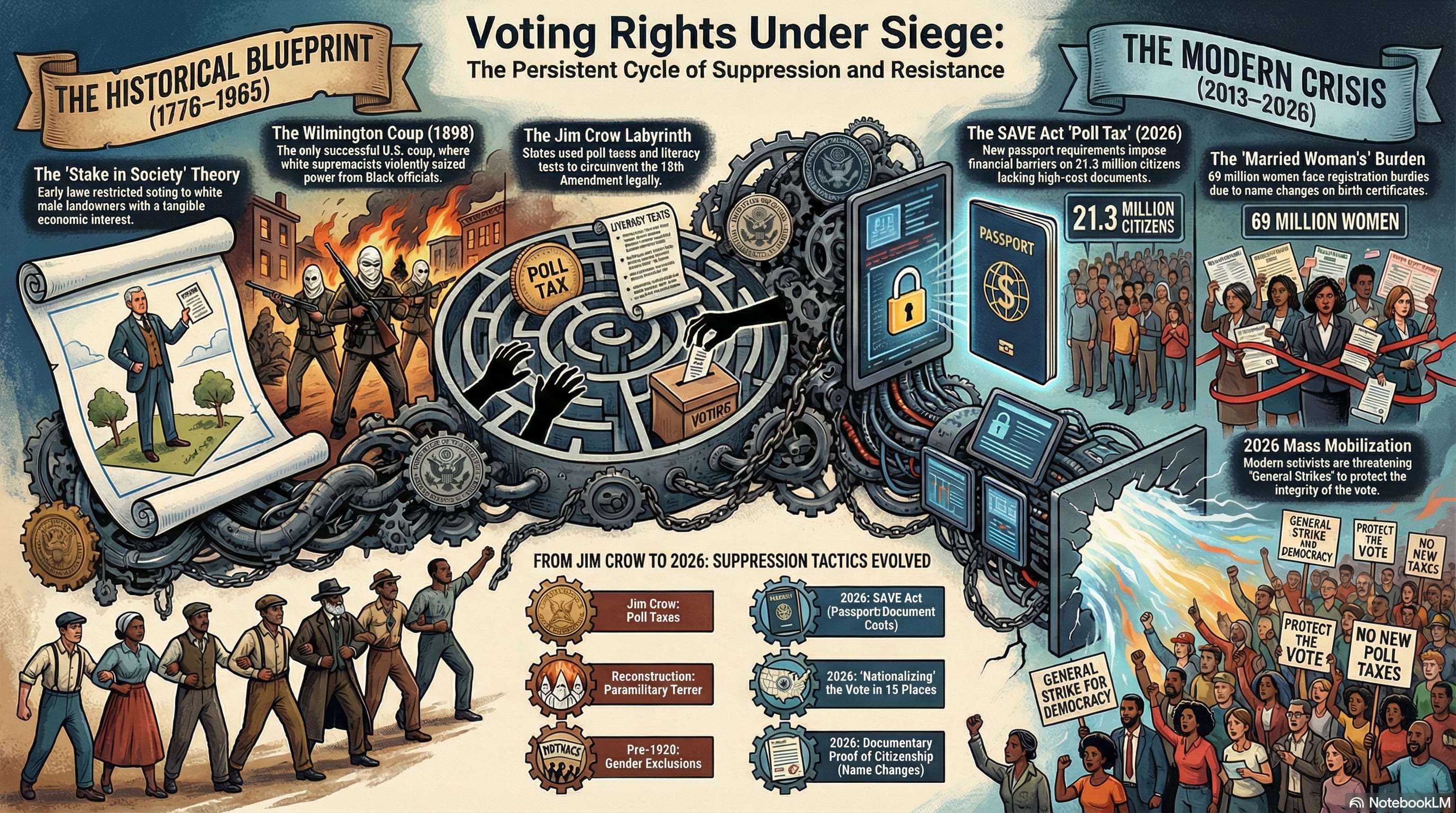
Introduction: The Perennial Struggle for the Ballot
The history of the franchise in the United States is not, as often mythologized, a linear and inevitable march toward universal suffrage. Rather, it is a volatile and cyclical narrative of expansion followed by violent retraction, of legal victories met with bureaucratic resistance, and of a democratic ideal perpetually at war with the exclusionary impulses of power. From the founding of the republic, where the vote was a privilege reserved for the propertied few, to the present constitutional crisis of February 2026, where the “Save America Act” threatens to reimpose financial barriers to citizenship, the ballot box has remained the central theater of American political conflict.
As of February 2026, the United States stands at a precipice. The Republican-controlled House of Representatives, facing the prospect of a “wipe-out” in the upcoming midterm elections, has introduced legislation that critics argue constitutes a modern-day poll tax, potentially violating the 24th Amendment.1 Simultaneously, former President Donald Trump has called for the “nationalization” of elections in specific Democratic strongholds, a strategy that echoes the “Redeemer” tactics of the post-Reconstruction South.3 This report provides an exhaustive analysis of this struggle, tracing the lineage of voter suppression from the “free white person” standards of 1790 to the “documentary proof of citizenship” requirements of 2026. It examines the resistance that has risen to meet every wave of suppression, from the abolitionists and suffragettes to the civil rights marchers and the modern coalitions threatening general strikes to protect the integrity of the vote.
Chapter I: The Exclusive Republic — Property, Race, and the Founding Era (1776–1860)
The “Stake in Society” Theory and Property Qualifications
The architects of the American experiment did not envision a democracy in the modern sense. In 1776, the right to vote was inextricably linked to the ownership of land. The prevailing political philosophy, often termed the “stake in society” theory, posited that only those with a tangible economic interest in the community—specifically, freehold property—possessed the independence of judgment necessary to participate in civic life.4 Men without property, dependent on others for their wages and subsistence, were viewed as susceptible to corruption or coercion and thus unfit for the franchise.
In the thirteen original colonies, suffrage was restricted almost exclusively to white men who owned land or possessed a certain amount of taxable property.6 These restrictions were not uniform; they varied by state, creating a patchwork of exclusion. For example, in the 18th-century colonies, religious tests often accompanied property qualifications, barring Catholics, Jews, and Quakers from the ballot in various jurisdictions.6 This early period established a foundational precedent: the electorate was to be curated, not universal.
The Erasure of Women and the Doctrine of Coverture
For women, the denial of the vote was total and structural. The legal doctrine of coverture rendered a married woman “civilly dead” (civiliter mortua). Upon marriage, a woman’s legal identity was subsumed by that of her husband; she could not own property, sign contracts, or keep her own wages. Since she could not own property in her own right, she could not meet the property qualifications for voting, even if gender were not an explicit bar.
A singular and often overlooked exception existed in New Jersey. Between 1776 and 1807, the state’s constitution referred to voters as “inhabitants,” allowing unmarried women and widows who met the property requirement to vote.7 This “accidental” enfranchisement was ended by the state legislature in 1807, which restricted the vote to free white males, explicitly closing the loophole. This retraction illustrates a recurring theme: when marginalized groups successfully utilize the levers of power, the rules are often rewritten to exclude them.
The Racialization of Citizenship
While the early 19th century saw the expansion of the franchise for white men—the era of “Jacksonian Democracy” brought the abolition of property requirements in states like New Hampshire (1792) and North Carolina (1856)—this democratization was racially exclusive.6 As barriers fell for white men, they rose for free Black men. Between 1792 and 1838, states such as Pennsylvania, New Jersey, and Connecticut, which had previously allowed propertied Black men to vote, rewrote their constitutions to disenfranchise them.6
The Naturalization Act of 1790 codified this racial exclusion at the federal level, limiting eligibility for naturalized citizenship to “free white person[s]”.6 This statute effectively barred immigrants from Africa and Asia from ever becoming citizens, and by extension, voters. By the eve of the Civil War, the United States had transformed from a republic of property to a “white man’s republic,” where race had replaced class as the primary determinant of political inclusion.
Table 1: Early Voting Restrictions by State (Selected Examples)
State
Restriction Type
Target Population
Year of Restriction/Change
New Jersey
Gender & Race
Women & Free Blacks
1807 (Rescinded voting rights)
Pennsylvania
Race
Free Black Men
1838 (Disenfranchised)
North Carolina
Property
Men without land
1856 (Abolished property test for whites)
Federal
Race (Citizenship)
Non-white immigrants
1790 (Naturalization Act)
Chapter II: The First Reconstruction and the Campaign of Terror (1865–1900)
The conclusion of the Civil War and the abolition of slavery precipitated the most radical expansion of democracy in American history, followed by its most violent collapse. The Reconstruction era (1865–1877) was a brief window where the federal government enforced a multiracial democracy in the former Confederacy.
The Constitutional Revolution
The ratification of the 13th, 14th, and 15th Amendments dismantled the legal structures of slavery and ostensibly guaranteed citizenship and voting rights. The 15th Amendment (1870) specifically prohibited the denial of the vote based on “race, color, or previous condition of servitude”.4 Under the protection of federal troops, Black men registered to vote in massive numbers, electing over 2,000 Black officials to local, state, and federal offices, including U.S. Senators Hiram Revels and Blanche K. Bruce of Mississippi.
Paramilitary Terror and the Violent Overthrow
This political revolution provoked a ferocious counter-revolution. White supremacists, organizing under the banners of the Ku Klux Klan (KKK), the White League, and the Red Shirts, launched a campaign of domestic terrorism designed to physically eliminate the Black electorate.9 This was not random violence; it was strategic, electoral warfare.
The Colfax Massacre (1873)
The Colfax Massacre in Grant Parish, Louisiana, stands as the bloodiest single instance of racial carnage during Reconstruction. Following a contested gubernatorial election in 1872, a white paramilitary mob, armed with cannons and rifles, attacked the county courthouse where Black citizens and militia were defending their local government. The white mob overpowered the defenders and massacred approximately 150 Black men, many of whom were executed after surrendering.11
The legal aftermath was as devastating as the violence. In United States v. Cruikshank (1876), the Supreme Court overturned the convictions of the perpetrators, ruling that the 14th Amendment’s Due Process and Equal Protection clauses applied only to state actions, not the actions of private individuals.12 This ruling effectively signaled to white terrorist groups that they could murder Black voters with impunity, provided the state government did not officially sanction the act.
The Wilmington Coup (1898)
Decades later, the Wilmington Massacre of 1898 in North Carolina demonstrated the longevity of this terror. Wilmington was a thriving, majority-Black city with a “Fusionist” government of white Populists and Black Republicans. In November 1898, a mob of 2,000 white supremacists, led by prominent Democrats, launched a coup. They burned the offices of The Daily Record (a Black newspaper), murdered at least 60 Black residents, and forced the elected mayor and aldermen to resign at gunpoint.11 It remains the only successful coup d’état in United States history, a violent seizure of power that successfully terminated Black political participation in the city for generations.14
The Compromise of 1877
The federal commitment to Reconstruction withered in the face of this violence and Northern fatigue. The contested presidential election of 1876 between Rutherford B. Hayes and Samuel Tilden resulted in the Compromise of 1877. In a backroom deal, Hayes was awarded the presidency in exchange for the withdrawal of the remaining federal troops from the South.15 This abandonment left Black voters defenseless against the “Redeemers,” who moved swiftly to codify the suppression that violence had paved the way for.
Chapter III: The Jim Crow Labyrinth — Bureaucratic Apartheid (1900–1960)
With the physical resistance of the Reconstruction era crushed, Southern states turned to “legal” means to circumvent the 15th Amendment. The objective was to create a system that was racially neutral on its face but discriminatory in its application, a strategy the Supreme Court was willing to countenance for decades.
The Mechanics of Disenfranchisement
The “Mississippi Plan” of 1890 became the blueprint for the South. It utilized a suite of suppressive tools:
Poll Taxes: Beginning with Georgia in 1877, states instituted poll taxes—cumulative fees required to vote.9 For sharecroppers living in a cash-poor economy, these taxes were prohibitive. While they disenfranchised many poor whites, the “discretionary” enforcement by local officials often meant whites were overlooked while Blacks were rigorously charged.
Literacy Tests: These were the most insidious tools of the era. Voters were required to read and “interpret” a section of the state constitution to the satisfaction of the registrar.9 This created a subjective barrier where a white registrar could pass an illiterate white man who couldn’t read a stop sign, while failing a Black college professor for incorrectly interpreting a complex clause on habeas corpus.
Grandfather Clauses: To protect white voters from the snare of literacy tests, states like Louisiana and North Carolina enacted “grandfather clauses,” exempting men from these requirements if their grandfathers had been eligible to vote prior to 1867.18 Since Black men could not vote before 1867, this exemption applied exclusively to whites.
The White Primary: As the Democratic Party established one-party rule in the South, the general election became a formality. The real contest was the Democratic Primary. Defining themselves as “private clubs,” Democratic parties barred Black participation, effectively disenfranchising Black voters from the only election that mattered.19
The Suffrage Movement and its Racial Fracture
The ratification of the 19th Amendment in 1920 is often celebrated as the moment women won the vote. However, the reality was fractured by race. The suffrage movement itself was often segregated; in the 1913 suffrage parade in Washington D.C., Black women like Ida B. Wells were told to march at the back to avoid upsetting Southern white suffragists.20
When the amendment passed, it removed the barrier of sex, but for Black women in the South, the barriers of race—poll taxes, literacy tests, and violence—remained firmly in place. Black women in the North and West could vote, but millions in the South remained disenfranchised until 1965.7 The resistance of Black women, who organized in churches and clubs, was distinct from the white suffrage movement, fighting a dual battle against sexism and racism simultaneously.
Chapter IV: The Second Reconstruction — The Civil Rights Movement and the VRA (1960–1970)
By the early 1960s, the edifice of Jim Crow appeared impregnable. In Mississippi, only 5.3% of eligible African Americans were registered to vote in 1962.21 Dismantling this system required a coordinated assault that combined grassroots mobilization with federal legislative pressure.
SNCC, Freedom Summer, and the Price of Resistance
The Student Nonviolent Coordinating Committee (SNCC) and the Council of Federated Organizations (COFO) launched the Freedom Summer of 1964.21 This was a massive voter registration drive that brought white college students from the North to work alongside Black activists in Mississippi. The strategy was to draw the nation’s eyes to the violence of the South.
The cost was high. Three activists—James Chaney, Andrew Goodman, and Michael Schwerner—were abducted and murdered by the KKK near Philadelphia, Mississippi, with the collusion of the local sheriff’s department. Their deaths, and the subsequent federal investigation, galvanized national outrage.
Fannie Lou Hamer and the MFDP
A central figure in this resistance was Fannie Lou Hamer. A sharecropper from Ruleville, Mississippi, Hamer was fired, evicted, and brutally beaten in a Winona jail for attempting to register to vote in 1962.22 Unbowed, she co-founded the Mississippi Freedom Democratic Party (MFDP) to challenge the all-white, segregationist Mississippi delegation at the 1964 Democratic National Convention.
Her televised testimony before the Credentials Committee stripped the veneer of civility from the Jim Crow South: “Is this America, the land of the free and the home of the brave, where we have to sleep with our telephones off the hooks because our lives be threatened daily, because we want to live as decent human beings?”.24 President Lyndon B. Johnson, terrified of losing Southern support, called a hastily arranged press conference to interrupt the broadcast, but Hamer’s words were replayed on the evening news, shifting public opinion.
The Voting Rights Act of 1965
The violence of “Bloody Sunday” in Selma, Alabama, where John Lewis and other marchers were bludgeoned by state troopers on the Edmund Pettus Bridge, provided the final political impetus. In August 1965, President Johnson signed the Voting Rights Act (VRA).4
The VRA was a legislative masterpiece. It suspended literacy tests and, crucially, under Section 5, established a “preclearance” regime. Jurisdictions with a history of discrimination could not change any voting law without approval from the U.S. Department of Justice. For the first time, the burden of proof was shifted from the victim of discrimination to the perpetrator.
Chapter V: The Erosion — The Judicial Counter-Revolution (1970–2020)
For nearly fifty years, the VRA served as the “crown jewel” of civil rights legislation, re-enfranchising millions. However, as the partisan composition of the Supreme Court shifted, a judicial counter-revolution began to dismantle these protections.
Shelby County v. Holder (2013)
The watershed moment came on June 25, 2013. In Shelby County v. Holder, the Supreme Court, in a 5-4 decision written by Chief Justice John Roberts, struck down Section 4(b) of the VRA, the formula used to determine which states were subject to preclearance.26 Roberts argued that the formula was outdated and that “things have changed dramatically” in the South.
Justice Ruth Bader Ginsburg, in a scathing dissent, famously compared the ruling to “throwing away your umbrella in a rainstorm because you are not getting wet.” The consequences were immediate. Within 24 hours, Texas and North Carolina implemented strict voter ID laws that had previously been blocked by the DOJ. North Carolina’s law was later described by a federal appeals court as targeting Black voters “with almost surgical precision”.17
Brnovich v. DNC (2021)
The erosion continued with Brnovich v. Democratic National Committee (2021). The Court upheld Arizona policies that discarded out-of-precinct ballots and criminalized “ballot harvesting” (the collection of ballots by community groups).28 Writing for the majority, Justice Alito established new “guideposts” for interpreting Section 2 of the VRA (the nationwide ban on discriminatory voting practices). These guideposts made it significantly harder for plaintiffs to prove that a voting law is discriminatory, effectively prioritizing state interests in preventing “fraud”—even without evidence of such fraud—over the disparate impact on minority voters.
Chapter VI: The Crisis of 2026 — The SAVE Act and the Return of the “Poll Tax”
We arrive now at the precarious political moment of February 2026. The United States is bracing for the 2026 midterm elections. The Republican Party, holding a slim majority in the House and fearing a “wipe-out” loss, has launched a coordinated legislative and rhetorical offensive to reshape the electorate.
The “Save America Act” (SAVE Act)
In early 2026, the House passed the Safeguard American Voter Eligibility (SAVE) Act (H.R. 8281), often referred to as the Save America Act.1 The bill is framed as a measure to prevent noncitizen voting, a phenomenon that audits and experts consistently term extremely rare.30 However, its practical effects recall the restrictive mechanisms of the Jim Crow era.
The “Modern-Day Poll Tax”
The Act requires voters to present documentary proof of U.S. citizenship (DPOC) in person when registering to vote in federal elections.32 Standard “Real ID” driver’s licenses are deemed insufficient. Voters must produce a U.S. passport, a certified birth certificate, or a Certificate of Naturalization.
Critics, including the ACLU and the League of Women Voters, argue this constitutes a poll tax in violation of the 24th Amendment.34 The logic is economic:
Cost: A U.S. passport costs over $130. Certified birth certificates also carry fees. For the 21.3 million citizens who lack these documents, the law imposes a financial price on the right to vote.32
The “Married Woman’s” Burden: The Act disproportionately targets women. An estimated 69 million women have changed their names upon marriage. Their birth certificates (maiden name) do not match their current legal names (driver’s license). Under the SAVE Act, they would be required to produce not just a birth certificate, but also a marriage certificate (or divorce decree) to bridge the name gap, often incurring additional fees and bureaucratic delays.2
Note regarding the “25th Amendment” argument: While the user query references the “25th Amendment” in relation to the SAVE Act, this appears to be a conflation with the 24th Amendment (poll taxes). The 25th Amendment deals with presidential succession. However, snippet 38 reveals that Republican Rep. Chip Roy has discussed the SAVE Act and the 25th Amendment in the same political breath—using the 25th to attack President Biden’s capacity while using the SAVE Act to restrict the vote. This rhetorical duality characterizes the chaotic political strategy of the 2026 GOP, but the legal argument against the SAVE Act rests on the 24th Amendment.
The MEGA Act
Complementing the SAVE Act is the Make Elections Great Again (MEGA) Act, introduced by Rep. Bryan Steil.39 This legislation aims to federalize restrictive election policies by:
Banning universal vote-by-mail.
Banning ranked-choice voting.
Banning “ballot harvesting”.
Eliminating the post-election grace period for mail-in ballots.39
The “15 Places” Strategy and “Nationalizing” the Vote
Beyond legislation, the 2026 strategy involves direct executive and administrative interference. Former President Donald Trump has explicitly called for Republicans to “take over the voting” in “at least 15 places”—a reference understood to target Democratic strongholds in swing states, such as Detroit, Philadelphia, Atlanta, and Phoenix.3
Trump’s call to “nationalize the voting” represents a paradoxical shift for a party that traditionally champions state sovereignty.3 By arguing that “the state is an agent for the federal government,” Trump advocates for federal intervention to seize control of election administration in cities likely to produce Democratic votes. This rhetoric is matched by action: in Georgia, the State Election Board has passed rules allowing local officials to refuse certification of results based on undefined “reasonable inquiries,” creating a mechanism to stall the 2026 midterm count and invite chaos.42
Chapter VII: The Resistance — Organizing in the Face of Suppression (February 2026)
The response to these threats has been swift and multifaceted, echoing the resistance movements of the past.
Legal Warfare
Civil rights organizations are waging a trench war in the courts. The ACLU, NAACP Legal Defense Fund (LDF), and the Brennan Center have filed suits challenging the SAVE Act (should it pass the Senate) and related executive orders.44 They have already secured a victory in League of Women Voters Education Fund v. Trump, where a federal court permanently blocked an attempt to impose proof-of-citizenship requirements via executive fiat, ruling that the President lacks the authority to rewrite election law.46
The “General Strike” and Mass Mobilization
The rhetoric of resistance has escalated to levels unseen since the 1960s. Senator Ruben Gallego (D-AZ) has publicly urged Americans to prepare for a “general strike” if the Trump administration or GOP-led House attempts to “nationalize” the 2026 midterms. “If you’re a pilot, do not show up. If you drive a train, do not show up... We grind the country to a halt,” Gallego declared, framing the defense of the vote as a matter of national survival.47
Grassroots Organizing
At the local level, groups like Florida Rising and the League of Women Voters are pivoting to “cure” strategies—helping voters navigate the new document requirements and ensuring that “voter purges” are challenged in real-time.48 They are conducting massive education campaigns to ensure married women and students procure the necessary “Real ID” or passport cards months before the November 2026 election, turning the bureaucratic hurdles into mobilization targets.
The Supreme Court: A Glimmer of Hope?
While the Supreme Court has been the architect of the VRA’s erosion, its recent decision in Moore v. Harper (2023) offered a critical lifeline. By rejecting the “Independent State Legislature” theory, the Court affirmed that state courts still have the power to review election laws under state constitutions.49 This preserves a vital avenue for resistance, allowing state supreme courts to strike down extreme gerrymanders and suppression laws even when the federal courts refuse to intervene.
Conclusion: The Fragility of the Franchise
The history of voting rights in the United States is a testament to the fragility of democracy. The rights won by the blood of the Civil War and the activism of the Civil Rights Movement were not permanent victories; they were strategic gains in an ongoing war. The tactics of 2026—the SAVE Act, the MEGA Act, the certification refusals—are not new inventions. They are the digital-age descendants of the poll tax and the grandfather clause.
The requirement of a passport to vote in 2026 mirrors the requirement of property to vote in 1776: both tether the rights of citizenship to economic status. The refusal to certify elections in Georgia mirrors the refusal to seat Black legislators in 1870. Yet, the spirit of resistance is equally enduring. From the “New Departure” of the suffragettes to the Freedom Summer of SNCC, and now the “General Strike” warnings of 2026, the American people have consistently organized to expand the boundaries of the “We” in “We the People.” The outcome of the 2026 midterms will not merely determine the balance of power in Washington; it will serve as a referendum on whether the mechanisms of suppression can once again overwhelm the demand for a truly universal franchise.
Table 2: The Evolution of Suppression and Resistance (1870–2026)
Era
Suppression Mechanism
Target Population
Method of Resistance
Post-Reconstruction (1870-1900)
KKK Violence, Poll Taxes, Literacy Tests
Freedmen (Black Men)
14th/15th Amendments, Union Leagues
Jim Crow (1900-1960)
Grandfather Clauses, White Primaries
Black Voters, Poor Whites
NAACP Litigation (Smith v. Allwright), SNCC
Post-Shelby (2013-2020)
Voter ID Laws, Polling Place Closures
Black & Latino Voters, Students
“Souls to the Polls,” Litigation
The “Save” Era (2021-2026)
SAVE Act (Proof of Citizenship), “15 Places” Takeover
Naturalized Citizens, Married Women
General Strike Threats, 24th Amendment Suits
The struggle continues. The ballot remains, as it always has been, a prize to be fought for, not a gift to be received.
Works cited
H.R.22 - 119th Congress (2025-2026): SAVE Act, accessed February 12, 2026, https://www.congress.gov/bill/119th-congress/house-bill/22
House passes SAVE Act, which could make it harder for women to ..., accessed February 12, 2026, https://19thnews.org/2026/02/house-passes-save-america-act-married-women-vote/
Trump wants to ‘nationalize the voting.’ What does that mean?, accessed February 12, 2026, https://www.spotlightpa.org/news/2026/02/trump-nationalize-voting-elections-2026-republicans/
Voting Rights: A Short History - Carnegie Corporation of New York, accessed February 12, 2026, https://www.carnegie.org/our-work/article/voting-rights-timeline/
History of Voting | Flagler County Elections Office, accessed February 12, 2026, https://www.flaglerelections.gov/Get-Involved/Voter-Education/History-of-Voting
Voting rights in the United States - Wikipedia, accessed February 12, 2026, https://en.wikipedia.org/wiki/Voting_rights_in_the_United_States
The 19th Amendment, Explained | Brennan Center for Justice, accessed February 12, 2026, https://www.brennancenter.org/our-work/research-reports/19th-amendment-explained
History of Voting Rights | Hawk The Vote - The University of Iowa, accessed February 12, 2026, https://vote.uiowa.edu/resources-0/history-voting-rights
Disfranchisement after the Reconstruction era - Wikipedia, accessed February 12, 2026, https://en.wikipedia.org/wiki/Disfranchisement_after_the_Reconstruction_era
Reconstruction era - Wikipedia, accessed February 12, 2026, https://en.wikipedia.org/wiki/Reconstruction_era
A Brief History of Voter Suppression Efforts in the United States - Learning for Justice, accessed February 12, 2026, https://www.learningforjustice.org/sites/default/files/2023-06/Voter-suppression-timeline--06132023_0.pdf
Parchment Rights - Harvard Law Review, accessed February 12, 2026, https://harvardlawreview.org/forum/vol-135/parchment-rights/
American Coup: Wilmington 1898 | Full Documentary | American Experience | PBS, accessed February 12, 2026,
Terror to Overturn Reconstruction Era Advances - Zinn Education Project, accessed February 12, 2026, https://www.zinnedproject.org/collection/terror-to-overturn-reconstruction/
HIST 119 - Lecture 26 - Race and Reunion: The Civil War in American Memory, accessed February 12, 2026, https://oyc.yale.edu/history/hist-119/lecture-26
Disputed Election of 1876 | Miller Center, accessed February 12, 2026, https://millercenter.org/the-presidency/educational-resources/disputed-election-1876
Poll taxes in the United States - Wikipedia, accessed February 12, 2026, https://en.wikipedia.org/wiki/Poll_taxes_in_the_United_States
Grandfather clauses | Law | Research Starters - EBSCO, accessed February 12, 2026, https://www.ebsco.com/research-starters/law/grandfather-clauses
Grandfather Clauses, Literacy Tests, and the White Primary - Civil Rights - USLegal, accessed February 12, 2026, https://civilrights.uslegal.com/voting-rights/grandfather-clauses-literacy-tests-and-the-white-primary/
Between Two Worlds: Black Women and the Fight for Voting Rights (U.S. National Park Service), accessed February 12, 2026, https://www.nps.gov/articles/black-women-and-the-fight-for-voting-rights.htm
Freedom Summer - Wikipedia, accessed February 12, 2026, https://en.wikipedia.org/wiki/Freedom_Summer
Stunned By Her Thunder: Fannie Lou Hamer | In Custodia Legis - Library of Congress Blogs, accessed February 12, 2026, https://blogs.loc.gov/law/2021/02/stunned-by-her-thunder-fannie-lou-hamer/
“The Sweat and Blood of Fannie Lou Hamer” | National Endowment for the Humanities, accessed February 12, 2026, https://www.neh.gov/article/sweat-and-blood-fannie-lou-hamer
Fannie Lou Hamer’s Powerful Testimony | Freedom Summer - YouTube, accessed February 12, 2026,
Voting Rights Act of 1965 | NAACP, accessed February 12, 2026, https://naacp.org/find-resources/history-explained/legislative-milestones/voting-rights-act-1965
The Voting Rights Act: Historical Development and Policy Background | Congress.gov, accessed February 12, 2026, https://www.congress.gov/crs-product/R47520
Supreme Court Undercuts Strength of Voting Rights Act in Ruling on Remaining Anti-Discrimination Protections - Legal Defense Fund, accessed February 12, 2026, https://www.naacpldf.org/press-release/supreme-court-undercuts-strength-of-voting-rights-act-in-ruling-on-remaining-anti-discrimination-protections/
Brnovich v. Democratic National Committee - SCOTUSblog, accessed February 12, 2026, https://www.scotusblog.com/cases/case-files/brnovich-v-democratic-national-committee/
Brnovich v. Democratic National Committee | Brennan Center for Justice, accessed February 12, 2026, https://www.brennancenter.org/our-work/court-cases/brnovich-v-democratic-national-committee
GOP Congress moves to shape election law in Trump’s image, accessed February 12, 2026, https://cyberscoop.com/republicans-propose-save-america-act-mega-act-election-laws/
Five Things to Know About the SAVE Act - Bipartisan Policy Center, accessed February 12, 2026, https://bipartisanpolicy.org/article/five-things-to-know-about-the-save-act/
What You Need to Know About the SAVE Act - Campaign Legal Center, accessed February 12, 2026, https://campaignlegal.org/update/what-you-need-know-about-save-act
House Passes SAVE America Act Amid Fierce Voting Rights Clash, accessed February 12, 2026, https://evrimagaci.org/gpt/house-passes-save-america-act-amid-fierce-voting-rights-clash-528605
House Co-Sponsorship Memo 45646 Information - Pennsylvania General Assembly, accessed February 12, 2026, https://www.palegis.us/house/co-sponsorship/memo?memoID=45646
RE: What you need to know about REAL ID; U.S. House passes SAVE Act, accessed February 12, 2026, https://www.pahouse.com/FrielOtten/EmailArchive/?id=138122
SAVE Act Would Undermine Voter Registration for All Americans | Brennan Center for Justice, accessed February 12, 2026, https://www.brennancenter.org/our-work/analysis-opinion/save-act-would-undermine-voter-registration-all-americans
The SAVE Act Would Disenfranchise Millions of Citizens - Center for American Progress, accessed February 12, 2026, https://www.americanprogress.org/article/the-save-act-would-disenfranchise-millions-of-citizens/
Congressional Record - GovInfo, accessed February 12, 2026, https://www.govinfo.gov/content/pkg/CREC-2024-07-09/pdf/CREC-2024-07-09-house.pdf
Chairman Steil Unveils The Make Elections Great Again Act - Press Releases, accessed February 12, 2026, https://cha.house.gov/2026/1/chairman-steil-unveils-the-make-elections-great-again-act
Chairman Steil Unveils The Make Elections Great Again Act - Joint Committee on the Library Press Release | LegiStorm, accessed February 12, 2026, https://www.legistorm.com/stormfeed/view_rss/6934677/office/1789/title/chairman-steil-unveils-the-make-elections-great-again-act.html
What Trump’s call to ‘nationalize the voting’ could mean for the 2026 ..., accessed February 12, 2026, https://www.votebeat.org/2026/02/09/donald-trump-dan-bongino-nationalize-take-over-voting-2026-election/
Georgia election board approves another rule that could disrupt certification - WABE, accessed February 12, 2026, https://www.wabe.org/georgia-election-board-approves-another-rule-that-could-disrupt-certification/
Amid fears of a November crisis, states have legal mechanisms to ensure votes get certified, accessed February 12, 2026, https://www.votebeat.org/2024/08/22/presidential-election-certification-delays-trump-republicans-disputes-georgia-board-rule/
ACLU Condemns House Passage of SAVE America Act as Dangerous Assault on Democracy | American Civil Liberties Union, accessed February 12, 2026, https://www.aclu.org/press-releases/aclu-condemns-house-passage-of-save-america-act-as-dangerous-assault-on-democracy
Voting Rights Groups Challenge Trump’s Recent Executive Order | American Civil Liberties Union, accessed February 12, 2026, https://www.aclu.org/press-releases/voting-rights-groups-challenge-trumps-recent-executive-order
Court Strikes Down Key Part of Trump’s Unlawful Voting Executive Order, Permanently Blocking Show-Your-Papers Requirement | American Civil Liberties Union, accessed February 12, 2026, https://www.aclu.org/press-releases/court-strikes-down-key-part-of-trumps-unlawful-voting-executive-order-permanently-blocking-show-your-papers-requirement
‘Grind the country to a halt’: Democrat urges national strike if Trump ..., accessed February 12, 2026, https://www.theguardian.com/us-news/2026/feb/06/donald-trump-voting-midterms-democrat-national-strike
News - State Voices Florida, accessed February 12, 2026, https://statevoicesfl.org/news/
Moore v. Harper | 600 U.S. ___ (2023) - Justia Supreme Court, accessed February 12, 2026, https://supreme.justia.com/cases/federal/us/600/21-1271/
==============================================================
Audio Podcast Discussion:
Video Overview:
Slide Deck Part 1:


Slide Deck Part 2:


